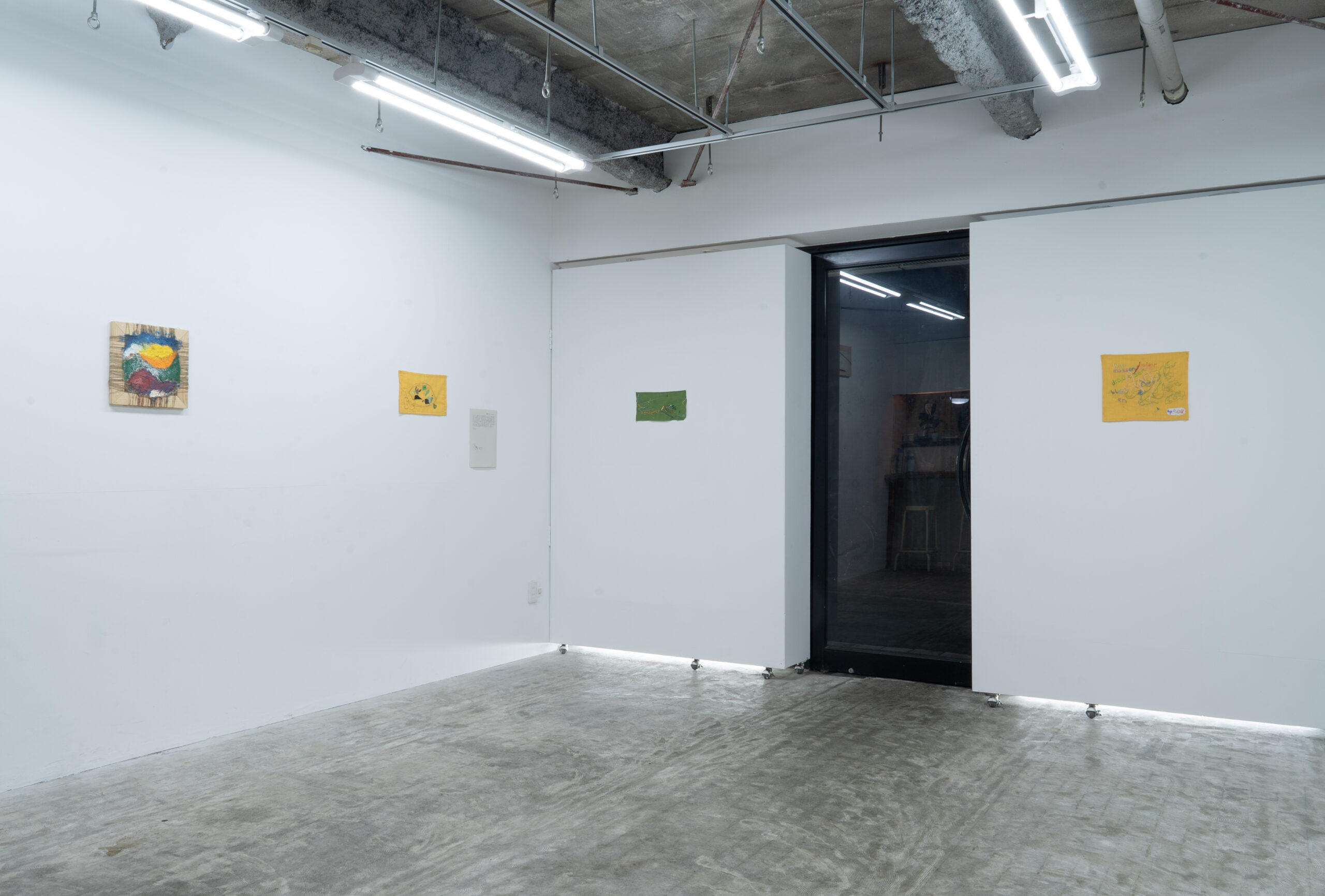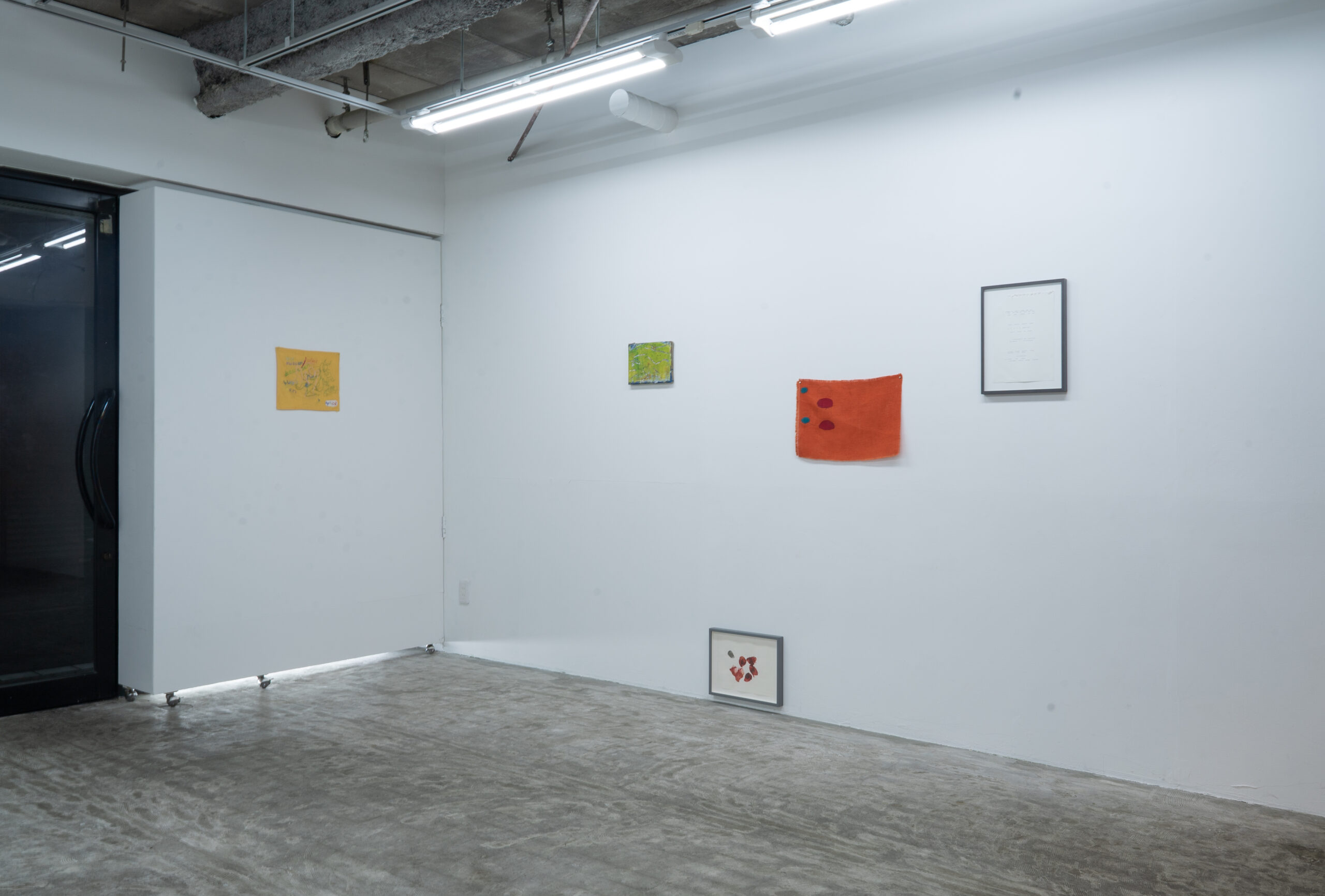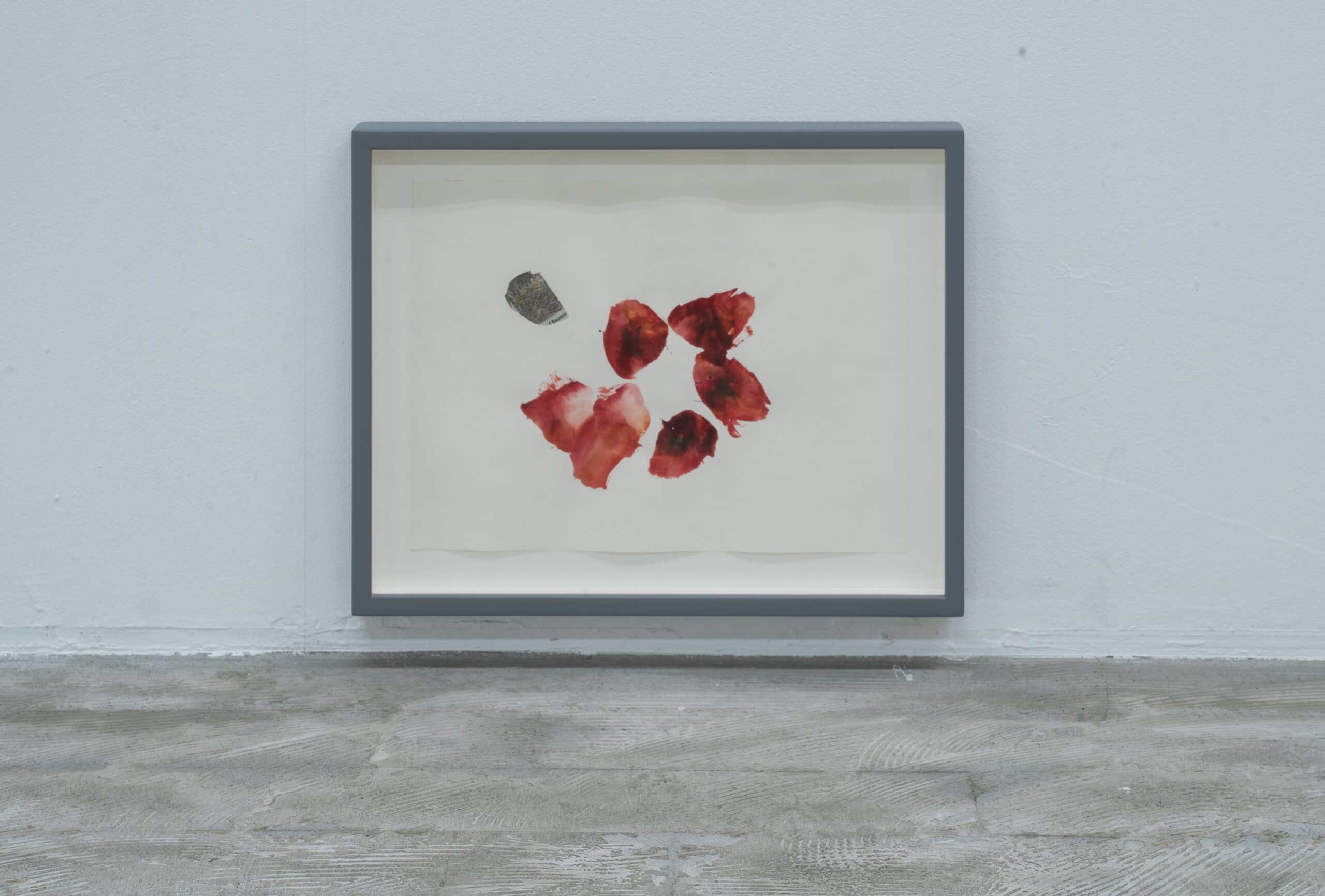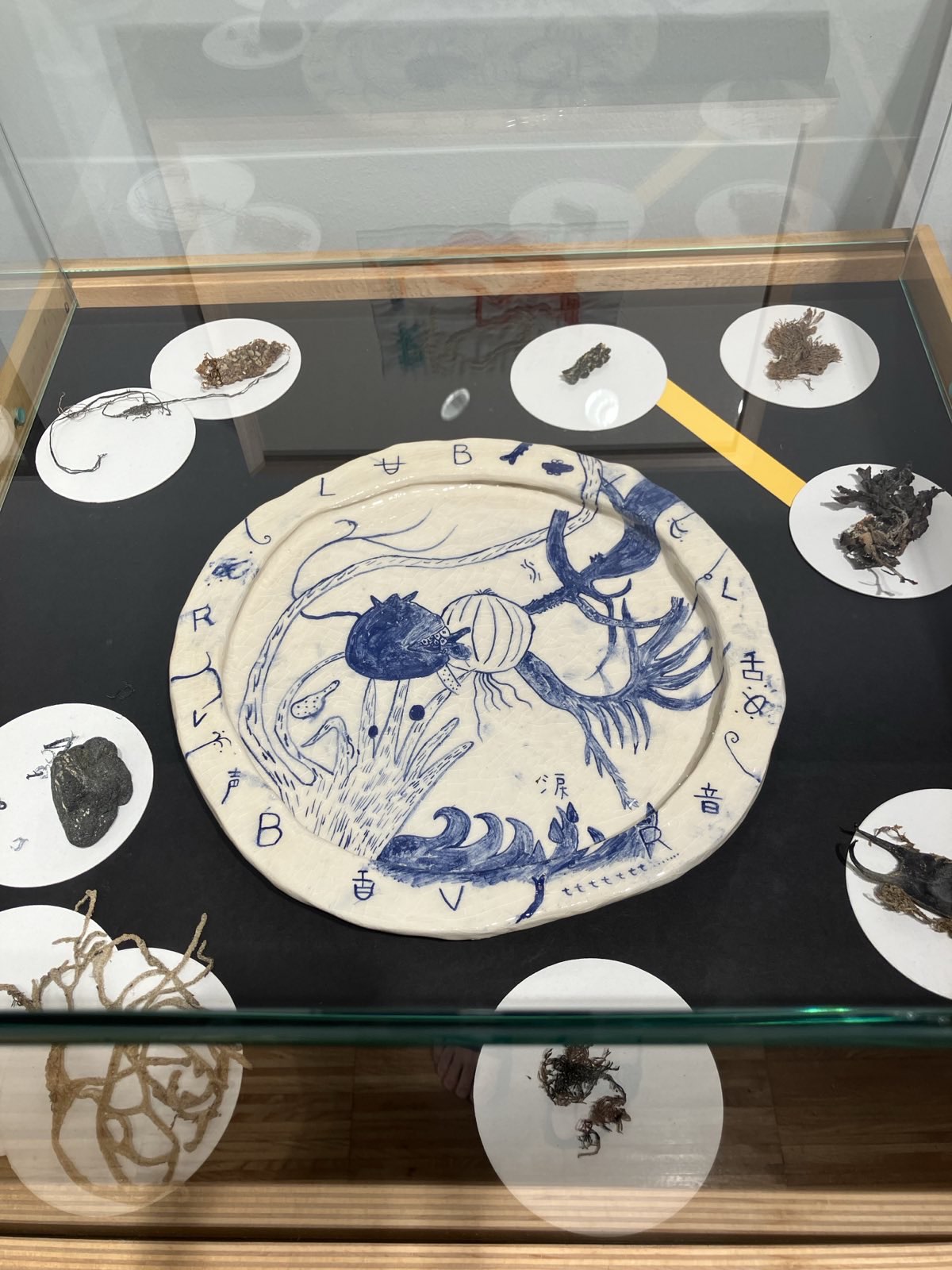
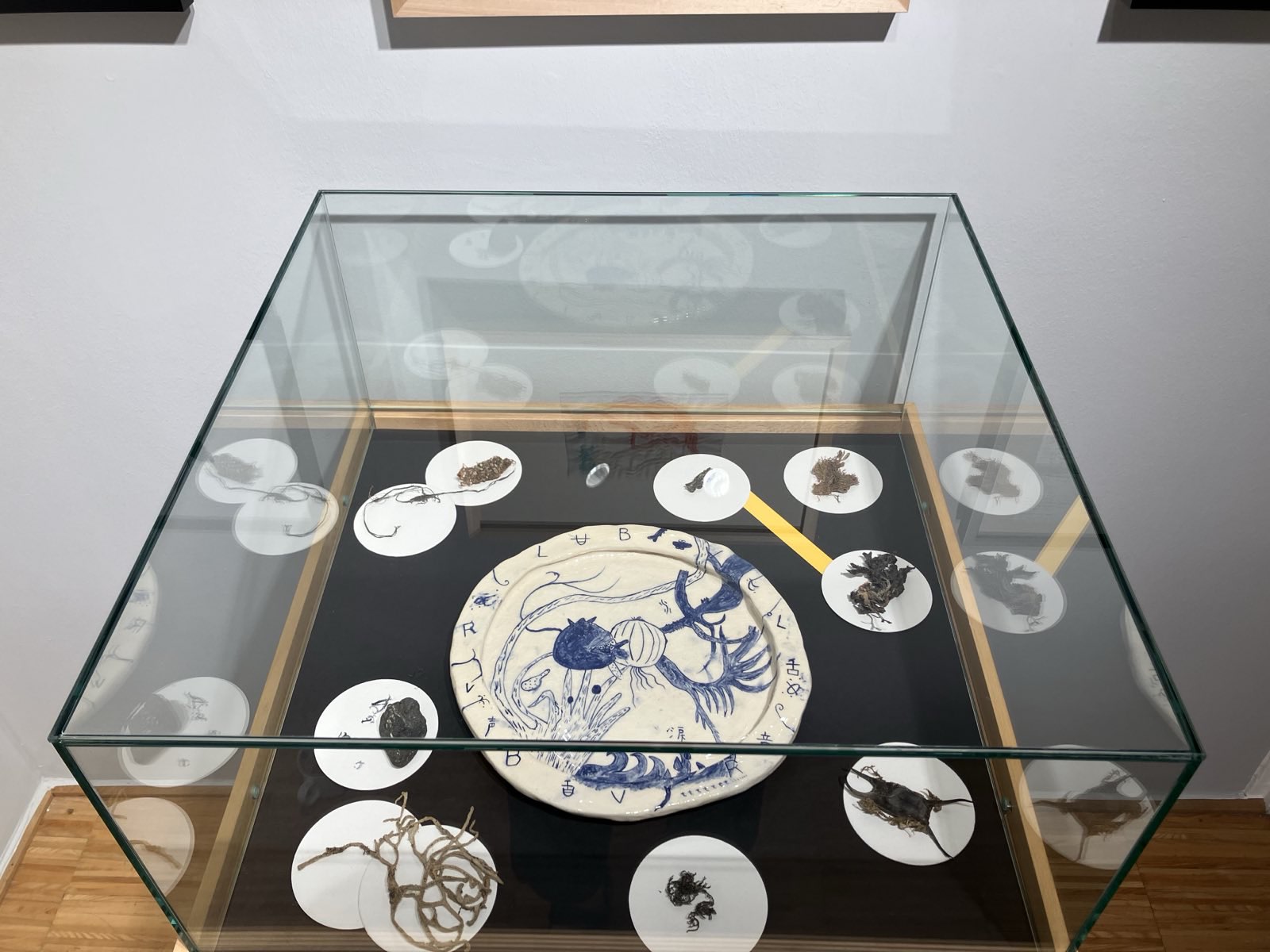
Seaweed Kissed a Rumor, 2024, Pottery
Seaweed Kissed a Rumor, 2024, Pottery
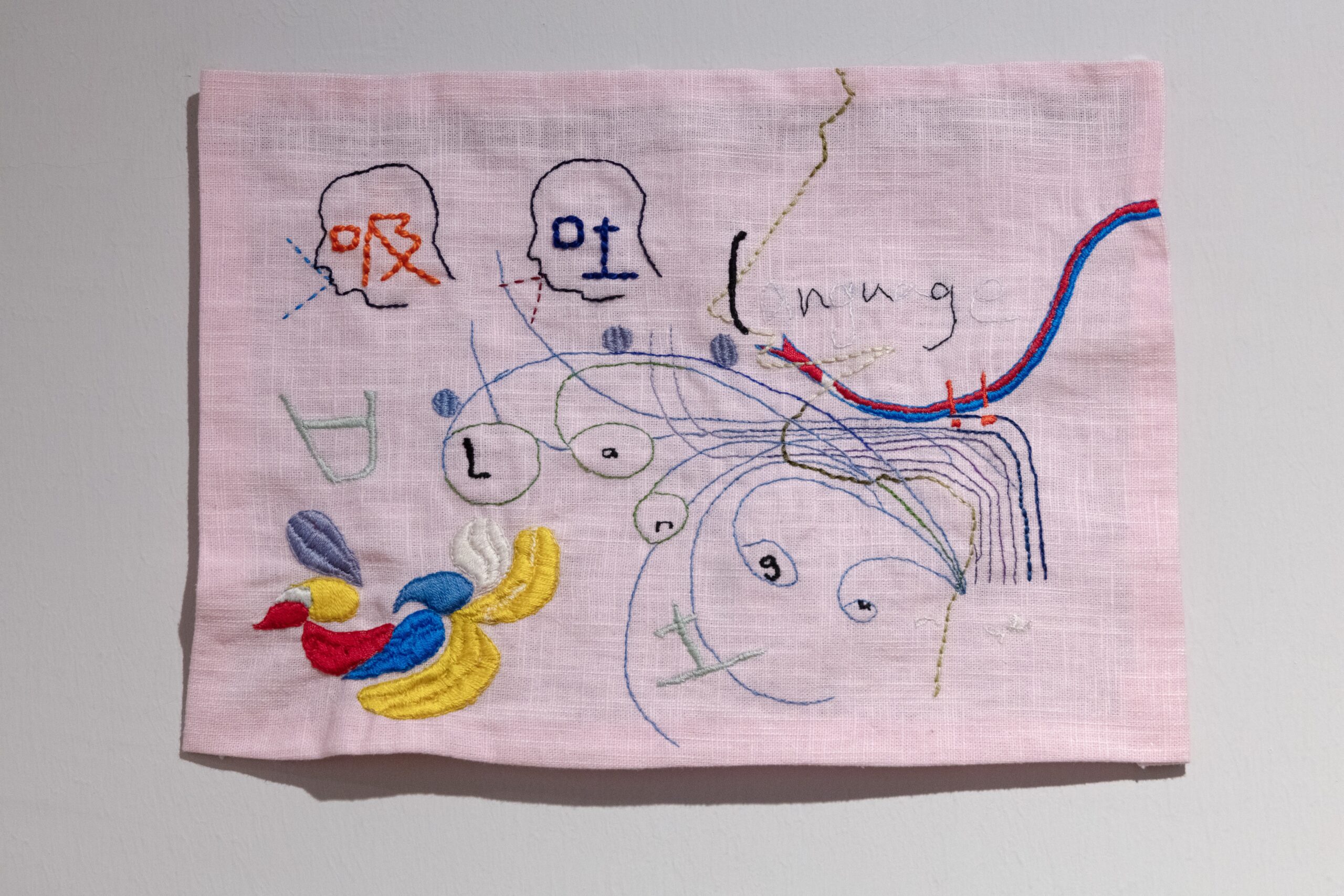
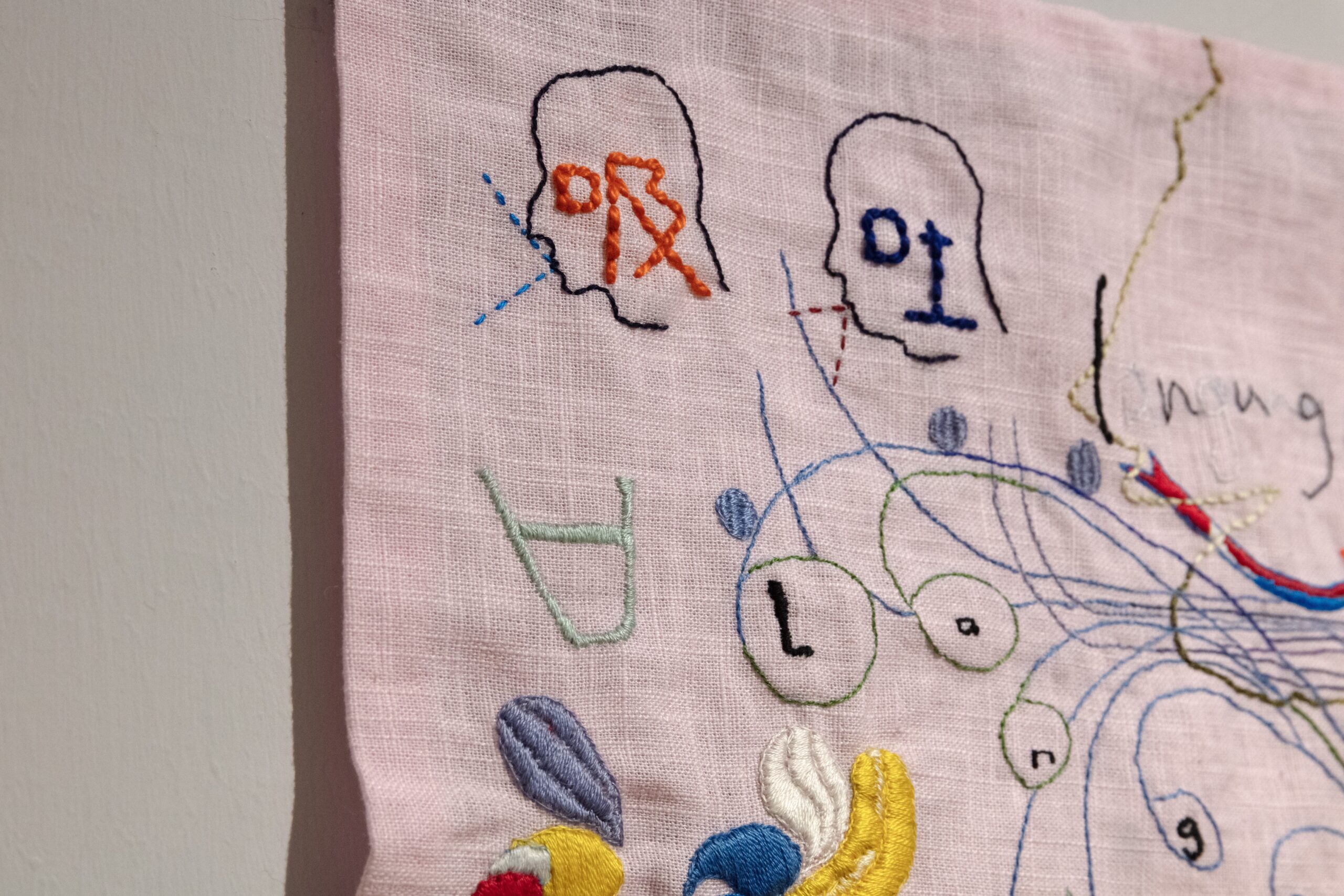
Traffic jam, 2025, hand stitching emboridery on fabric, 20 x 21 cm
Photo credit: Nele Hazod
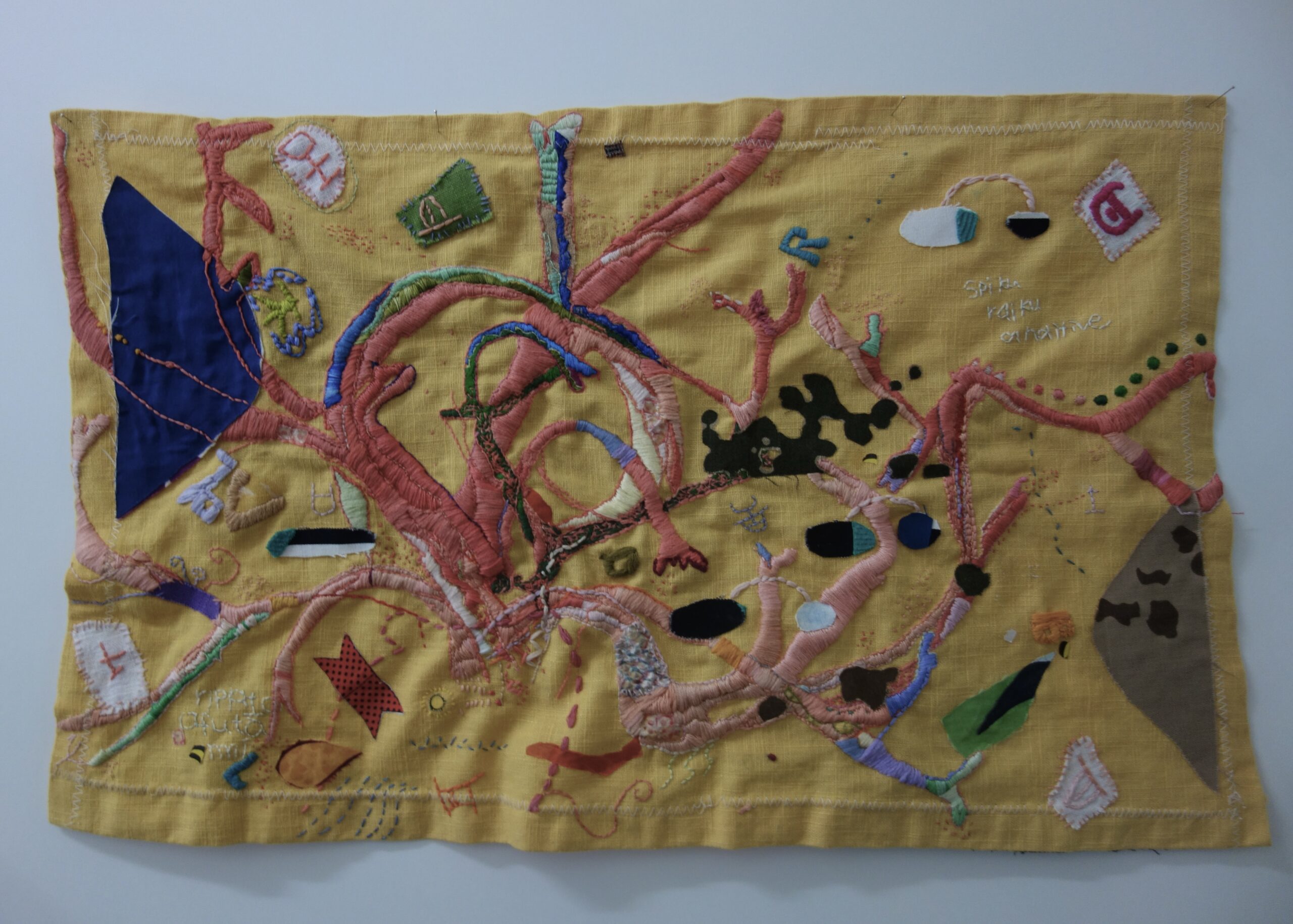
spiku raiku a neitibu (Speak Like A Native), 2024, textile collage with hand sitiching embroidery on fabric, 49x31cm
I had an idea for my textile collage with hand-stitched embroidery work titled spiku raiku a neitibu (Speak Like A Native), 2024, 49x31cm, from my life experience. When I speak English or German which are my second and third languages, I am misunderstood people what I say, because of my pronunciation. My accent does not sound like a native speaker. I practiced my tongue to pronounce these two languages correctly. I wanted to be a native speaker. But one day, somehow, I stopped disciplining my tongue. Instead, I imagined that my tongue would become seaweed. My seaweed-tongue separates a few as many serpents’ tongues aggregate. It moves freely, sings, and speaks any language, not just human language. I communicate with animals, plants, and stars. I depicted such an imaginary scene in spiku raiku a neitibu (Speak Like A Native). How does language metamorphose when I struggle to make myself understood in a life outside of my mother tongue? The title of the work; spiku raiku a neitibu is allocated alphabets the English saying “Speak Like A Native.” is allocated to the alphabet, phonetically, into my pronunciation.
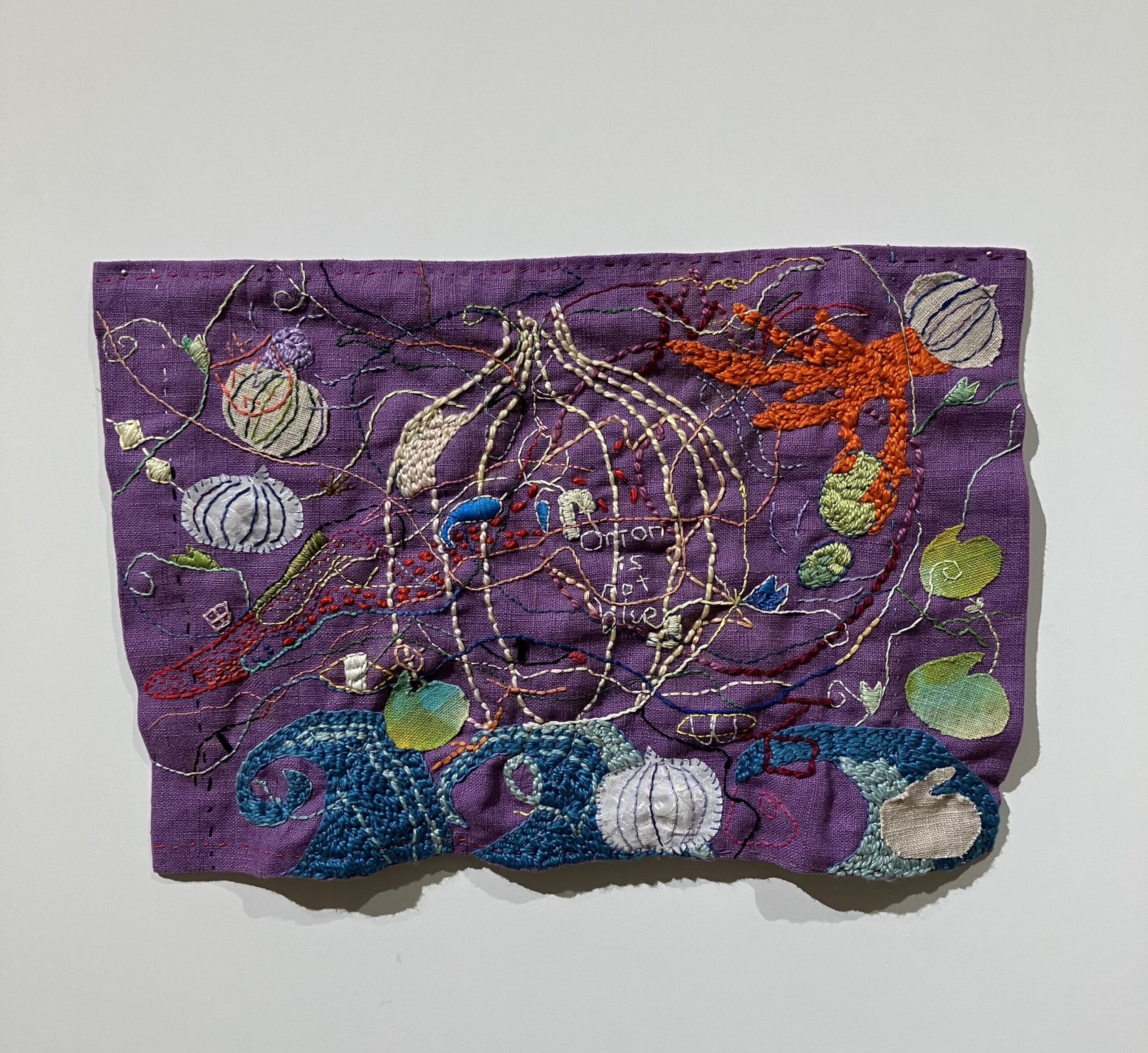
Onion Is Not Blue, 2024, textile collage with hand stitching emboridery, 30 x 20.5 cm
If patterns can speak, what are they willing to talk about? Could I listen to them? I had an idea about my textile work, Onion Is Not Blue through reading an article about Meissen porcelain’s Blue Onion (Zwiebelmuster). The Blue Onion’s name derives from a misunderstanding of a pattern of pomegranates as onions. The semioticity of the pattern is coded by cultural myth; it exposes a regulation of what you know and do not know. Onions, their name and representation have been performing well for the culture, instead of pomegranates. Even though fruits are not humans or animals, I can’t help but rescue pomegranates; the artworks sometimes can begin to be produced, not as a creation but as a negation, refusal, and re-contextualization. The title of the work used a negative form to reflect it.
– 柘榴 桃 玉葱
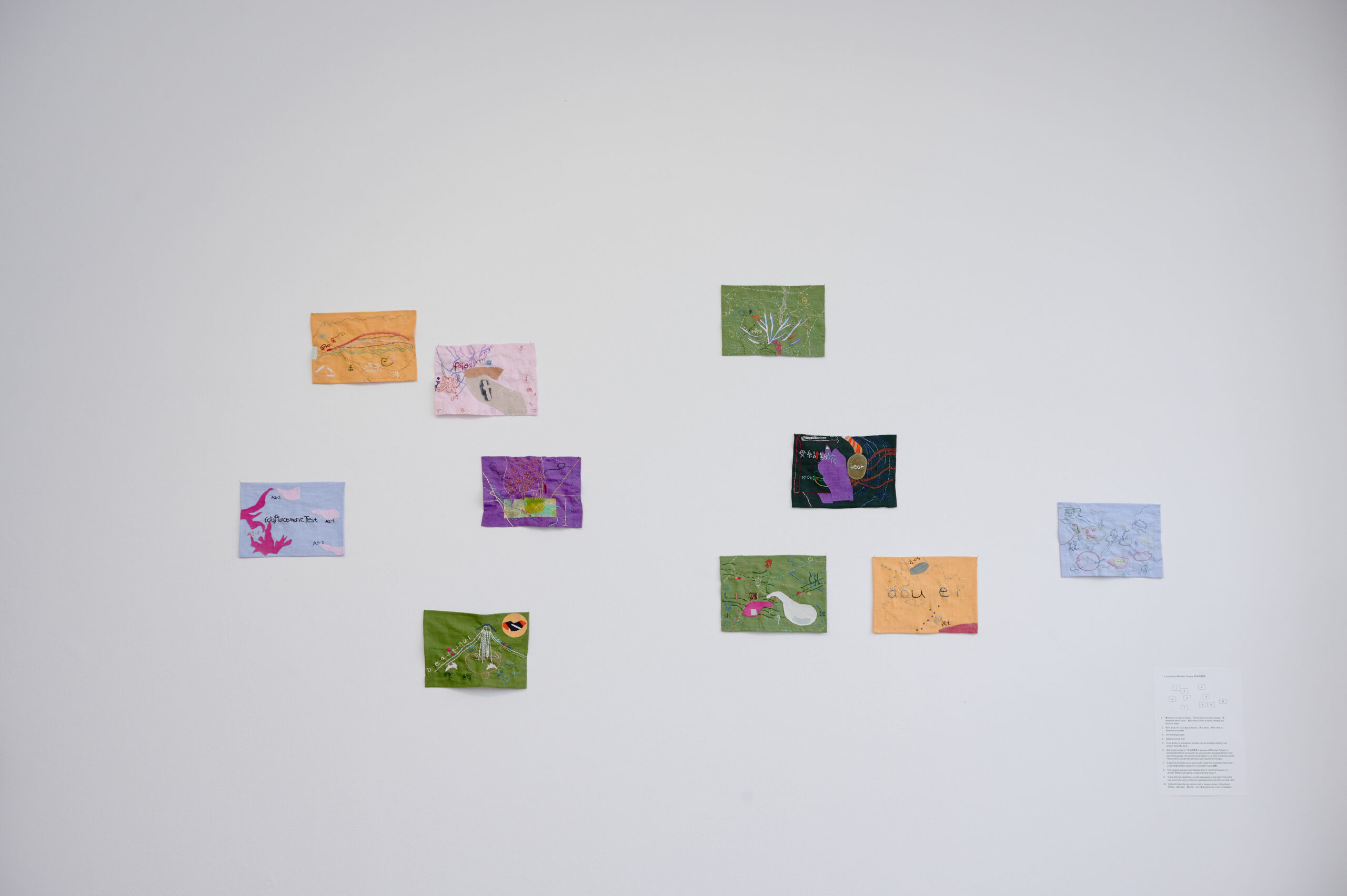
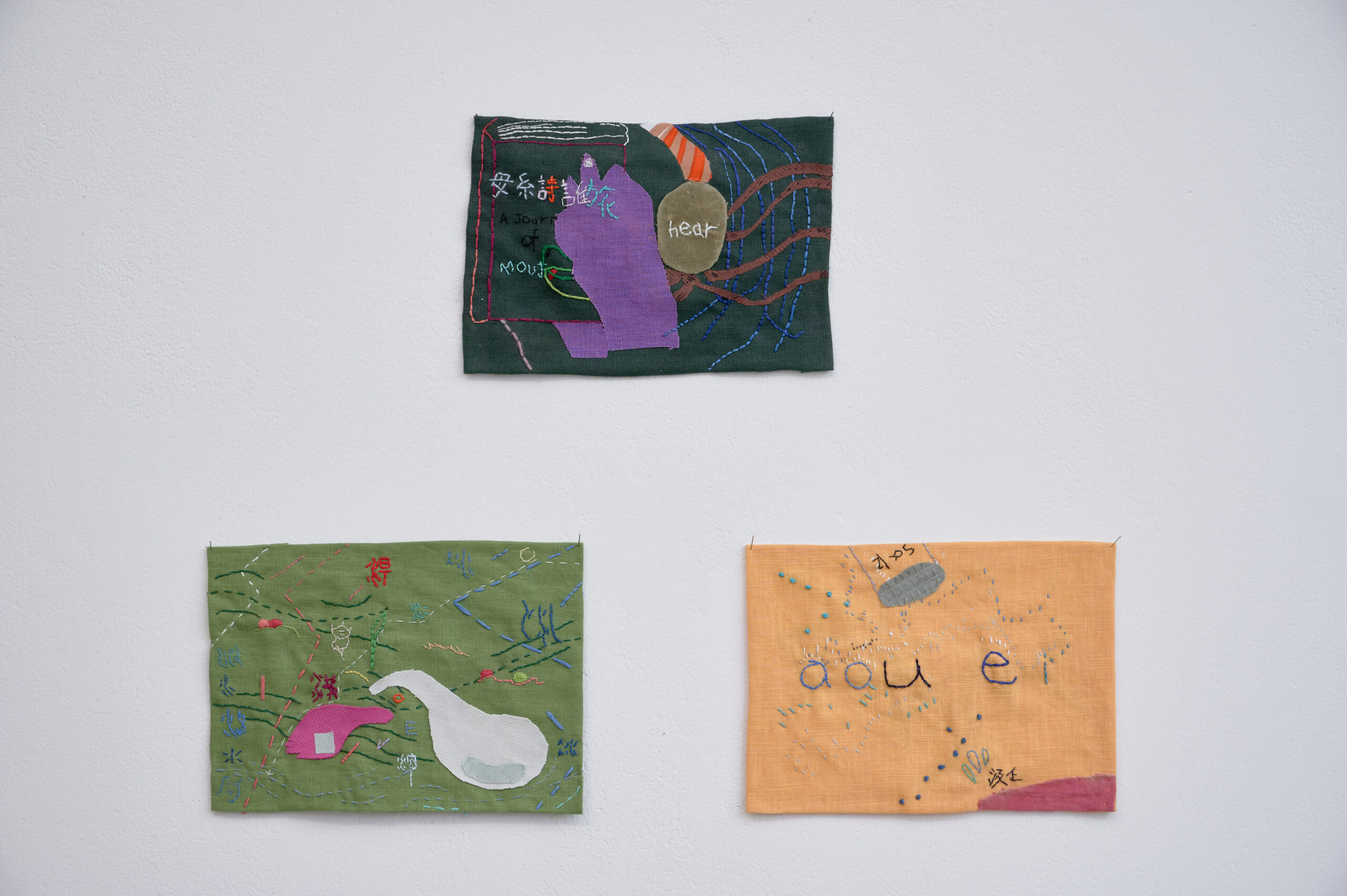
A Journey of Mouther Tongue 母糸詩誰旅, 2024, textile collage with hand stitching emboridery, various sizes
1. 痛 to hurt, to hate, to fullest、舌thousand mouthes, tongue、渡 ferryboat, ferry, cross、漂 to float, to drift, to wave, faraway, put them on water
2. Burn a ice !氷 ice cube, to freeze、泳 to swim、溶to melt, to dissolve, to soulble
3. die Seetangzungen
4. (dis)placement Test
5. A cat works on a reception handed over an invitation letter to her, written ‘Dear Ms. Asia’.
6. She found a book of “ 母糸詩誰旅 A Journey of Mouther Tongue” in her grandmother’s bookshelf. Her grandmother already had lost in her second language. Her grandmother spoke to her with mysterious words. Those words sounds like a Emojis spark grandma’s tongue.
7. A spirit of mountain has a buck-tooth. Under the mountain, there is an ocean,兎兎 rabbits skipped on crocodiles heads鰐鰐。
8. Two tongues discuss their attitude when if next time they are in a dentist. What of any genre of dance do they dance?
9. To eat German alphabets, on salt and pepper is fine taste. This is the tale about why some of German alphabets have two dots on a top- äöü.
10. If afterlife has only two options: hell or heaven we go, I am going to 浮float、溺drawn、漂draft、and 息breathe into a river in-between.
A Journey of Mouther Tongue 母糸詩誰旅 ははしたたび ははがしたたび? hahashitatabi
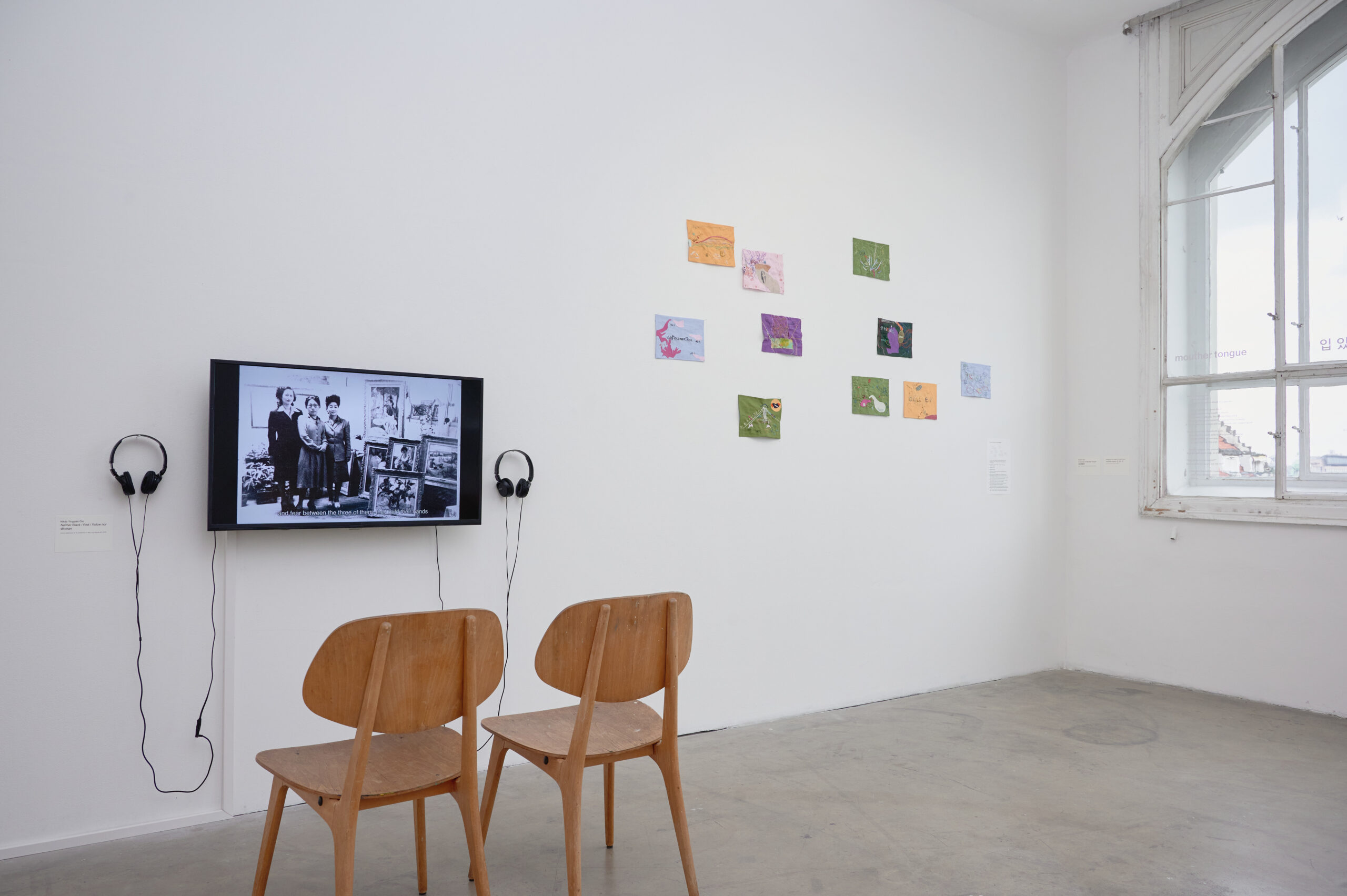
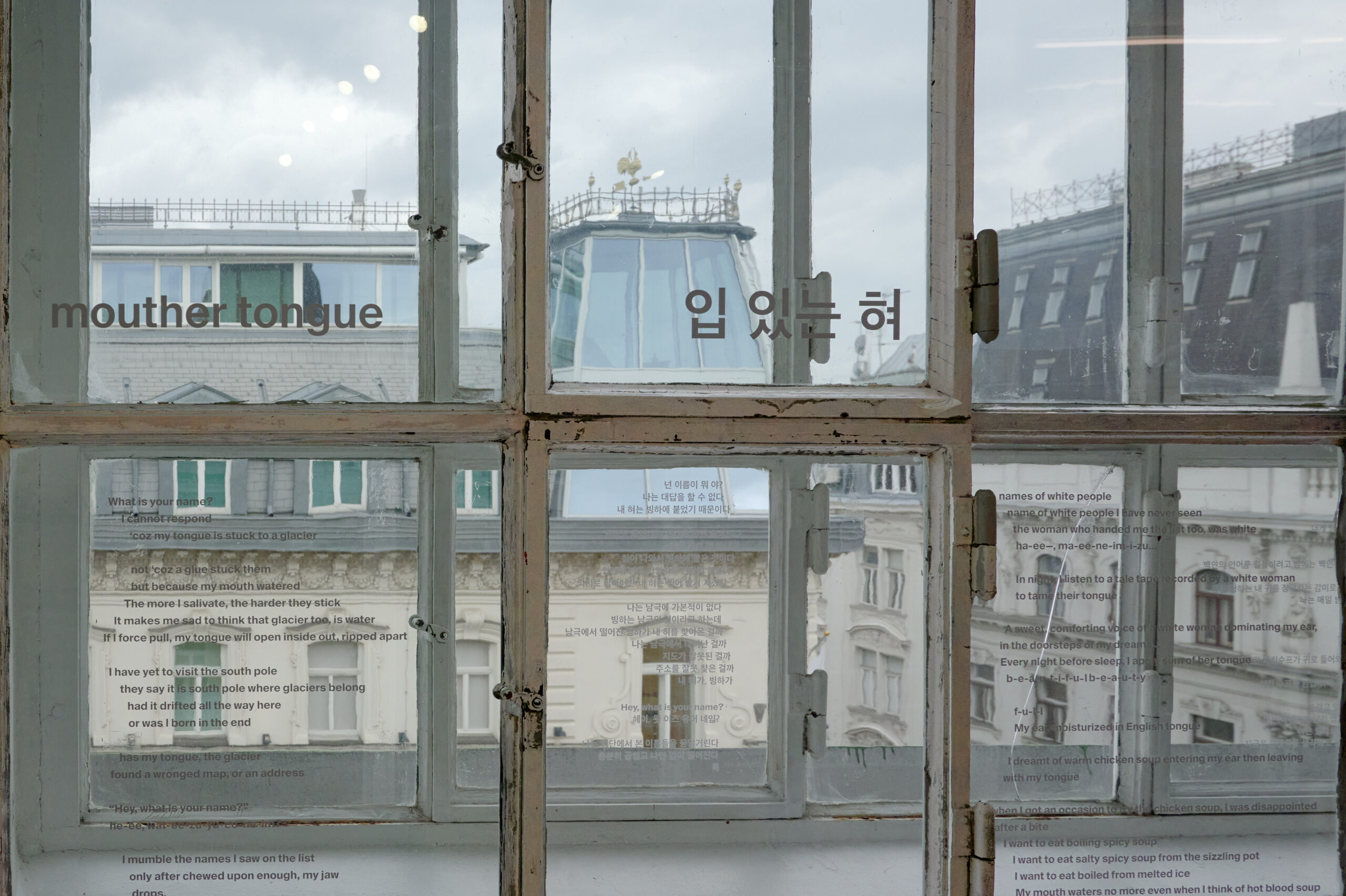
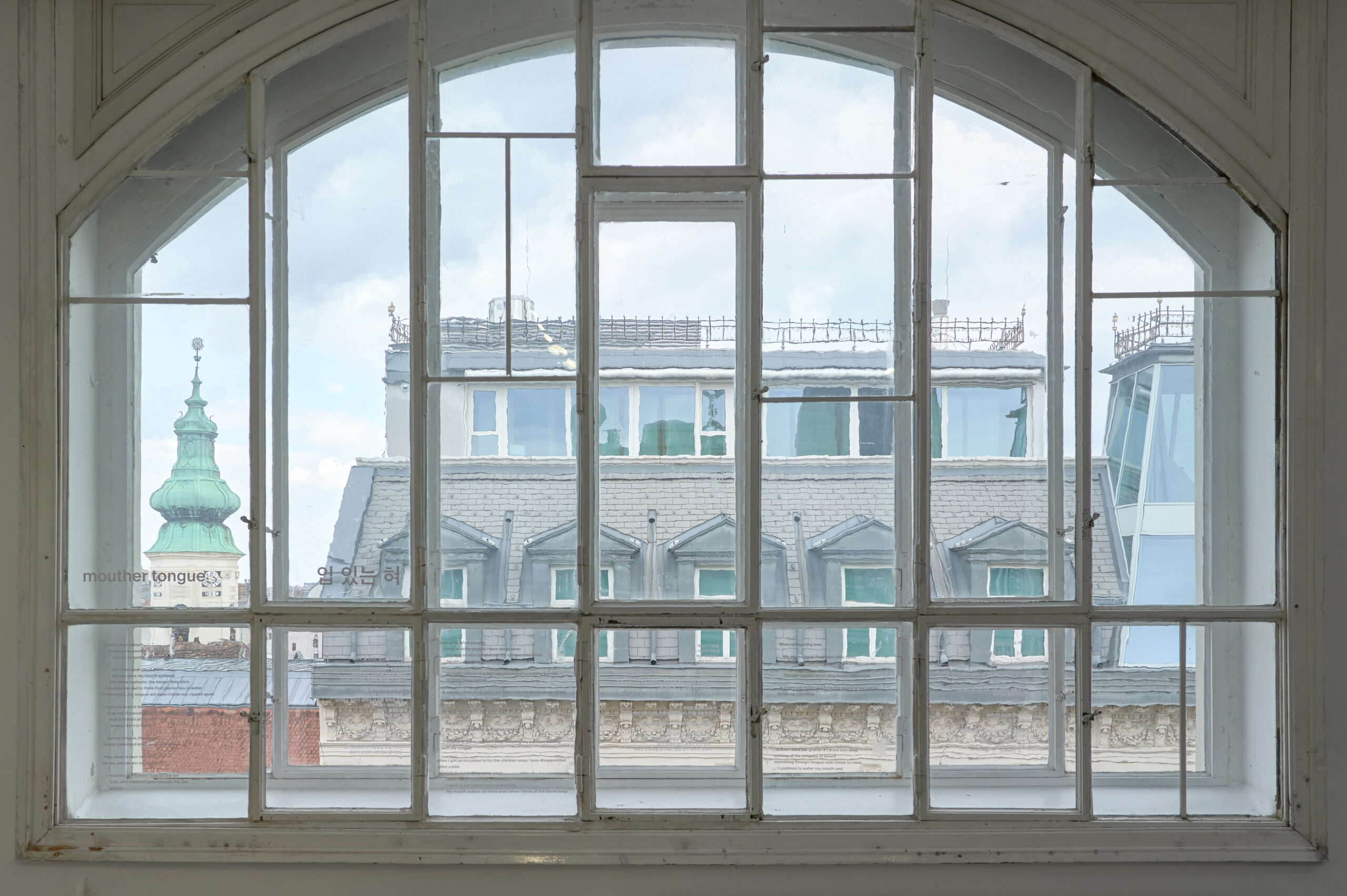
with mouther tongue 입 있는 혀 (2022/2024) by Kyungrim Lim Jang´s poem & designed by Hannah Sakai
I participate in the exhibition living library of becomings in Austrian Association of Women Artists (VBKÖ).
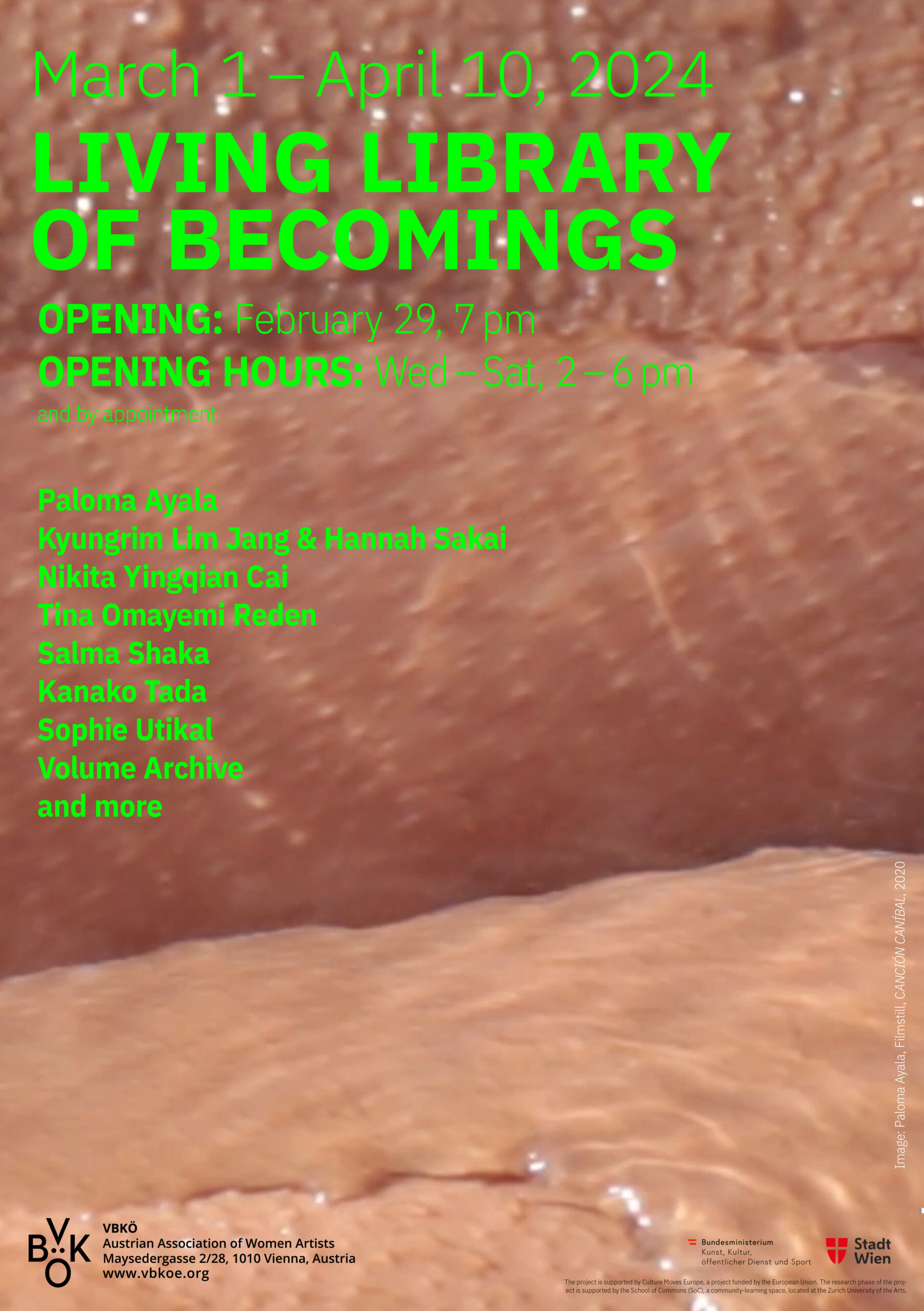
living library of becomings
March 1 – April 10, 2024
Opening: Thursday, February 29, 7 pm
Opening times: Wed – Sat 14:00-18:00
and by appointment (info@vbkoe.org)
Paloma Ayala, Nikita Yingqian Cai, Kyungrim Lim Jang & Hannah Sakai, Tina Omayemi Reden, Salma Shaka, Kanako Tada, Sophie Utikal, Volume Archive, and diverse publishing practices
Curated by Miwa Negoro
Exhibition design by Shi Yin
living library of becomings is a group exhibition derived from a performative library project dedicated to multiple narratives of intersectional, decolonial, queer feminist spirits. It draws inspiration from influential writings, Gloria Anzaldúa’s Borderlands, Theresa Hak Kyung Cha’s DICTEE, and Audre Lorde’s Uses of the Erotic that challenge the binary confines of destructive colonial modernity to transcend geopolitical, linguistic, and spiritual boundaries while nurturing an emancipatory power from within. Weaving together the resonating voices, the exhibition features the works that explore the shape-shifting bodies of water, thoughts, languages, and feelings as the fluid, transformative agency. It embraces the margin, the liminal, and its relation as an assemblage, recognizing the affects of proximity, displacement, and (dis)orientation in the moment of grief, loss, and liberation.
living library of becomings is a portal of encounters, bridging the past, and the present, to the future of intergenerational and transcultural feminist imaginations. Taking a library, as a living archival practice of voices, it transfers and shares the process of (un)becoming through knowing, listening, and touching, as something plural. The visitor is invited to spend their time reading a selection of textual materials from the library, including various artistic zines and collective publishing practices. During the exhibition, the space will be activated by a talk, performative interaction, somatic reading session, and reading performance.
The library includes the selection from VBKÖ Archive, Kunstraum Niederösterreich Library, VOLUMES Archive, and Mai Ling Library.
The performative library started in 2020, and its research phase is supported by the School of Commons (SoC), a community-learning space, located at the Zurich University of the Arts, in 2023-2024. The exhibition is supported by Culture Moves Europe, a project funded by the European Union.
Program:
Wednesday, March 13, 7 – 8:30 pm
Online talk “Decolonial Curatorial Practice as Collective Care
and Solidarity” by Kathy-Ann Tan
[Hybrid via zoom and onsite, in English]
Thursday, March 21, 7 – 8:30 pm
Activation “Preserving / Persevering: Food Containers”
by Salma Shaka
[in English]
Tuesday, March 26, 6 – 7:30 pm
Somatic Reading Session by Daliah Touré
[in English]
Sunday, April 7
Reading Performance of Gloria E. Anzaldúa’s Work by Auro Orso, with an Introduction by Verena Melgarejo Weinandt
[in German, English]
*Detailed information will be announced