つる、つる、つる、(Tsuru,Tsuru,Tsuru)

Ausstellungsgestaltung // Ann Cotten & Kanako Tada
Kuration // Barbara Zwiefelhofer

Eröffnung // Di, 4. März 2025, 19.00 Uhr
宴会は始まった、そして鳥の足は切られた。
Die Vernissage hat begonnen, dem Vogel wurden die Beine abgeschnitten.
Einführung / Musik / Performance mit Ann Cotten & Kanako Tada sowie Mario Schlager

Event // Do, 5. Juni 2025, 18.00 Uhr

Laufzeit // 5. März 2025 bis 30. Juni 2025
Öffnungszeiten  // Mo–Do: 09.00–17.00 Uhr

つる、つる、つる、(Tsuru, Tsuru, Tsuru)

つる、つる、つる、(Tsuru, Tsuru, Tsuru) ist die erste gemeinsame Ausstellung der in Iowa/USA geborenen und in Wien aufgewachsenen Schriftstellerin Ann Cotten und der in Hiroshima aufgewachsenen, seit 2017 in Wien lebenden und arbeitenden Künstlerin Kanako Tada.

Aus unterschiedlichen künstlerischen und sprachlichen Zusammenhängen kommend teilen sie ein großes Interesse an Sprache. In ihrer gemeinsamen künstlerischen Forschung befassen sie sich mit der Ästhetik sprachlicher Systeme und wie in solchen Systemen die Beziehungen grammatikalischer Figuren in Erscheinung treten. In drei Sprachen (Deutsch, Englisch, Japanisch) arbeiten heißt auch einen gewissen Kubismus leben, der immer neue Schlaglichter auf Gesellschaft, Normen und Gefühle wirft, dem die Einsichten hinterherstolpern.

Hellhörig für verschiedene Formen und Stile betreiben Cotten und Tada für sich und gemeinsam wildes, artiges und experimentelles Lesen, in der jeweils vertrauten wie in der unvertrauten Sprache. Während Tada Einflüsse aus Hiphop und dessen Aktionsmodus mit traditionellen Nähstilen kombiniert, Theorie und Literatur wie etwa von Susan Sontag oder Yoko Tawada liest und Bilder von Kumagai Morikazu oder Tatsuno Toeko zur visuellen Genealogie zählen könnte, verstrickt sich Cotten im Projekt ihrer materialistischen Poetik in Theorien der Bedeutung abseits des Mainstreams wie etwa von Oswald Wiener, Susan Blackmore, Henry Gates Jr. und 西田幾多郎 (Nishida Kitarō).

Im Literaturhaus Wien präsentieren Kanako Tada und Ann Cotten Schwerpunkte ihrer jahrelangen Zusammenarbeit – ergänzt um neue Arbeiten und ausgewählte intertextuelle und kunsthistorische Referenzen.

„Der Titel つる、 つる、 つる (Tsuru Tsuru Tsuru) spielt mit Klang, Form und Homophonie und ist der Wortspielerei von Tada entsprossen. Sprache besitzt neben der semiologischen auch eine künstlerische Wirklichkeit, die für ihre ständige Aktualisierung und Weiterentwicklung verantwortlich ist, aber aus der Perspektive der Alltagssprache kaum erfasst werden kann. Beim Anstarren unbekannter Buchstaben oder Zeichen kann Erhabenheit und Unruhe erlebt werden, bis hin zur Frustration. Doch aus der inneren Landschaft, die in der Zeit bis zur Bildung eines Verständnisses entsteht, sprießen mitunter Triebe in die Kunst hinein. Die Sprache ist ein riesiges Lebewesen (Elke Erb), mit dem wir alle zusammenleben. Sie kommt dahergespannt wie eine rankige Pflanze, schrumpft wie ein krampfender Muskel, hebt ab wie ein Kranich, um in eine ferne Gegend zu fliegen. Gene werden transportiert. Aber man kann es auch so sagen: Schlingpflanzen umschlingen den krampfenden Fuß, der Kranich schlägt hiflos mit den Flügeln.“ (Ann Cotten & Kanako Tada)


Literature Haus Vienna


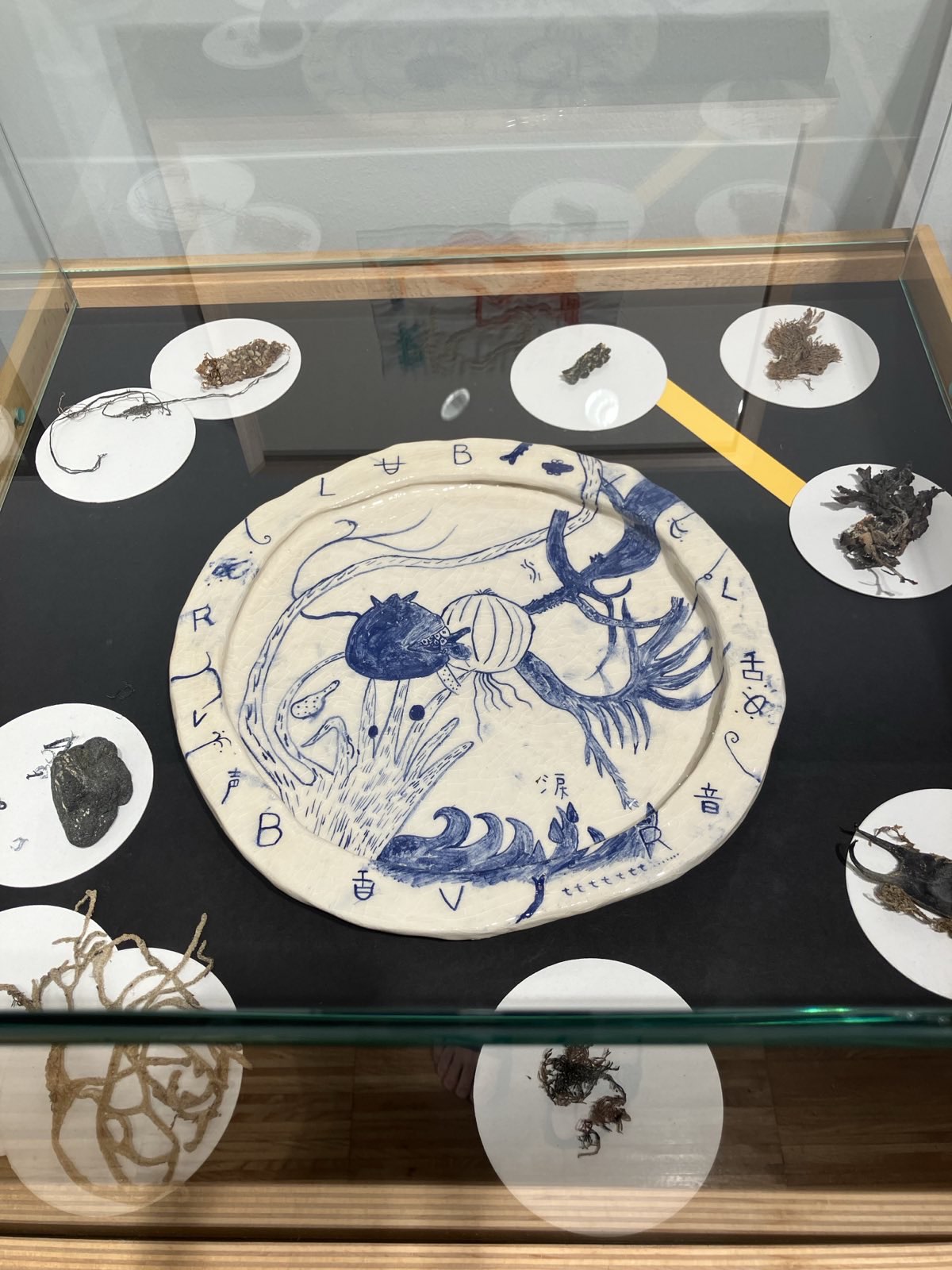
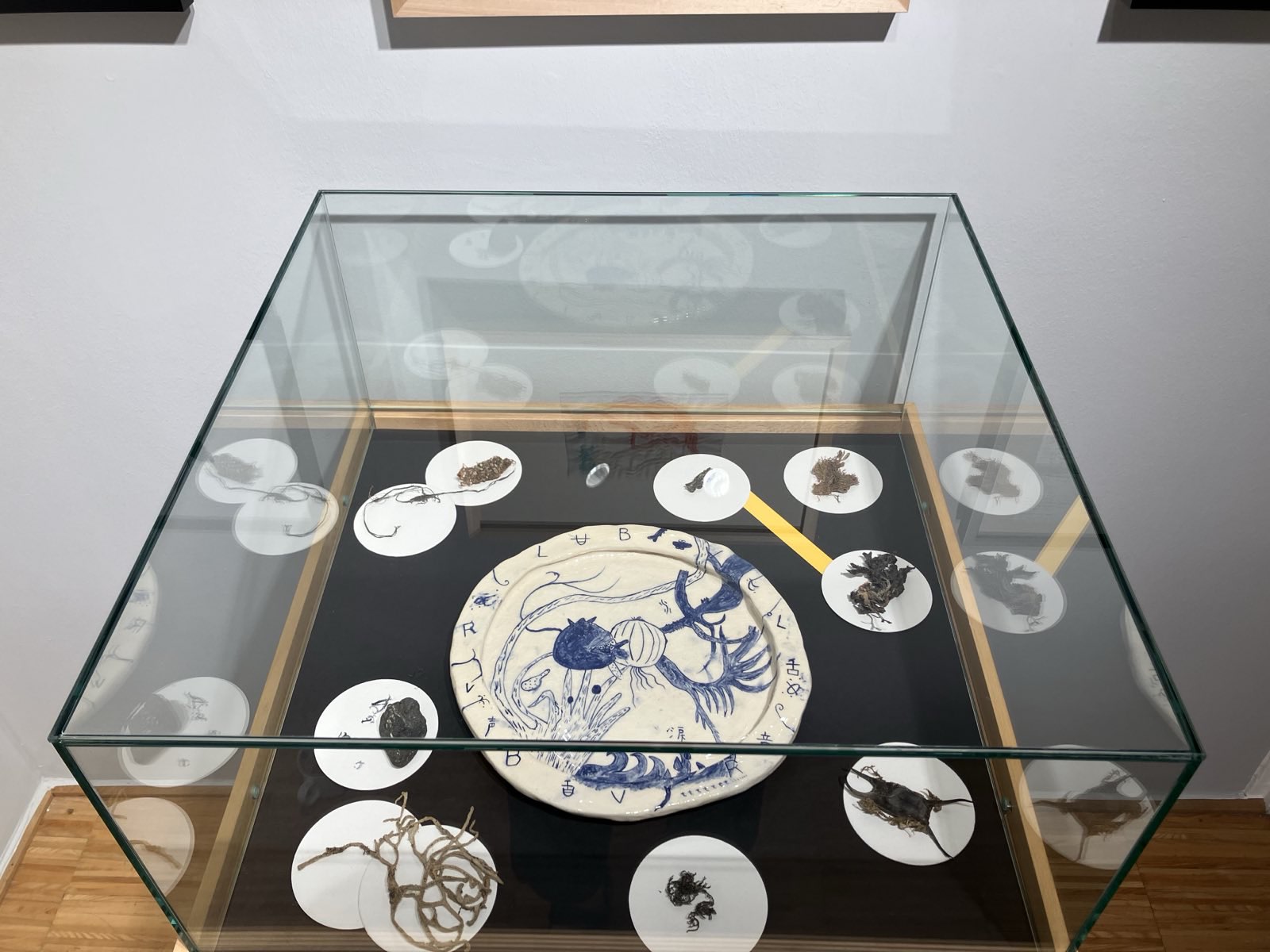
    Seaweed Kissed a Rumor, 2024, Pottery


Traffic jam, 2025, hand stitching emboridery on fabric, 20 x 21 cm

Photo credit: Nele Hazod

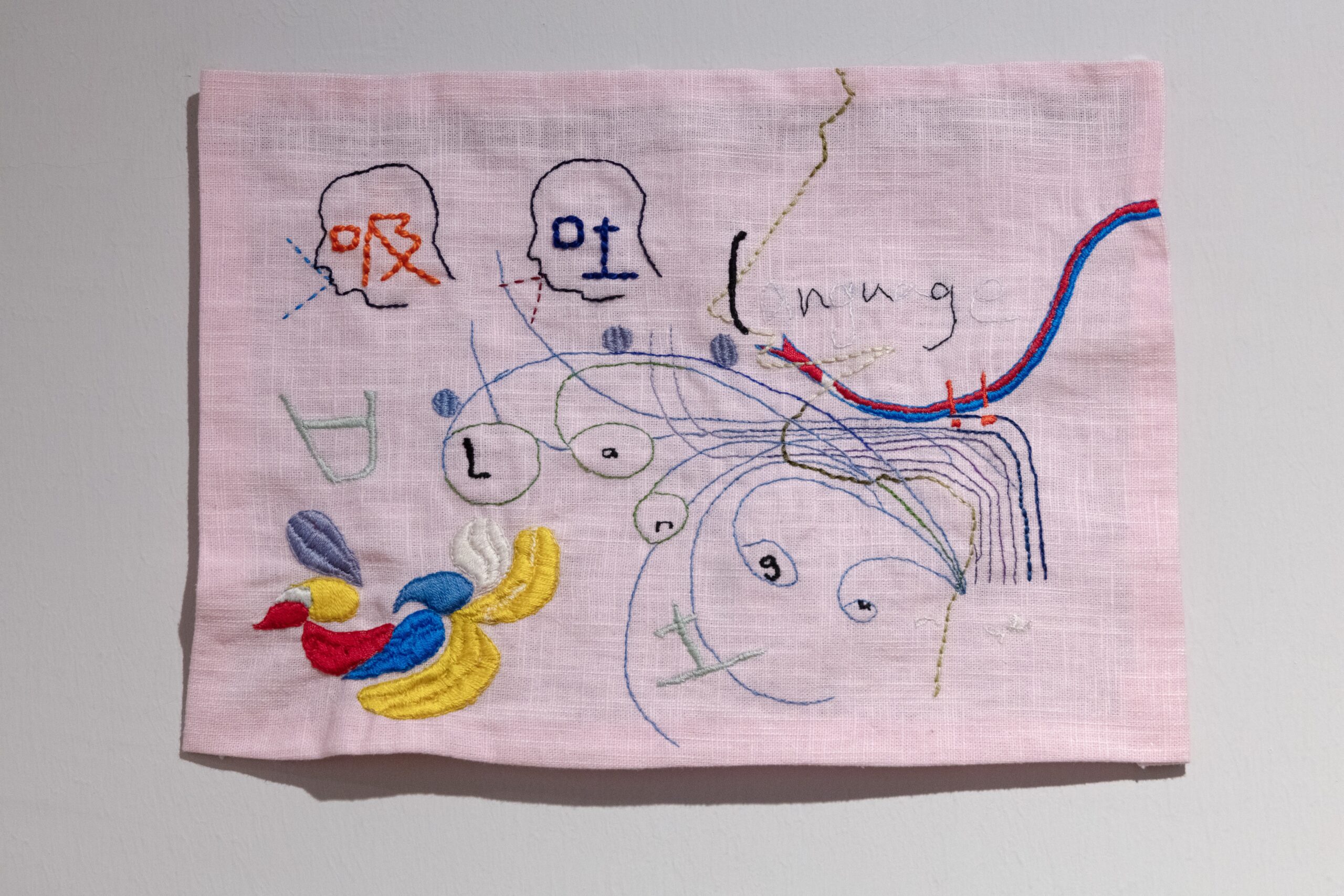
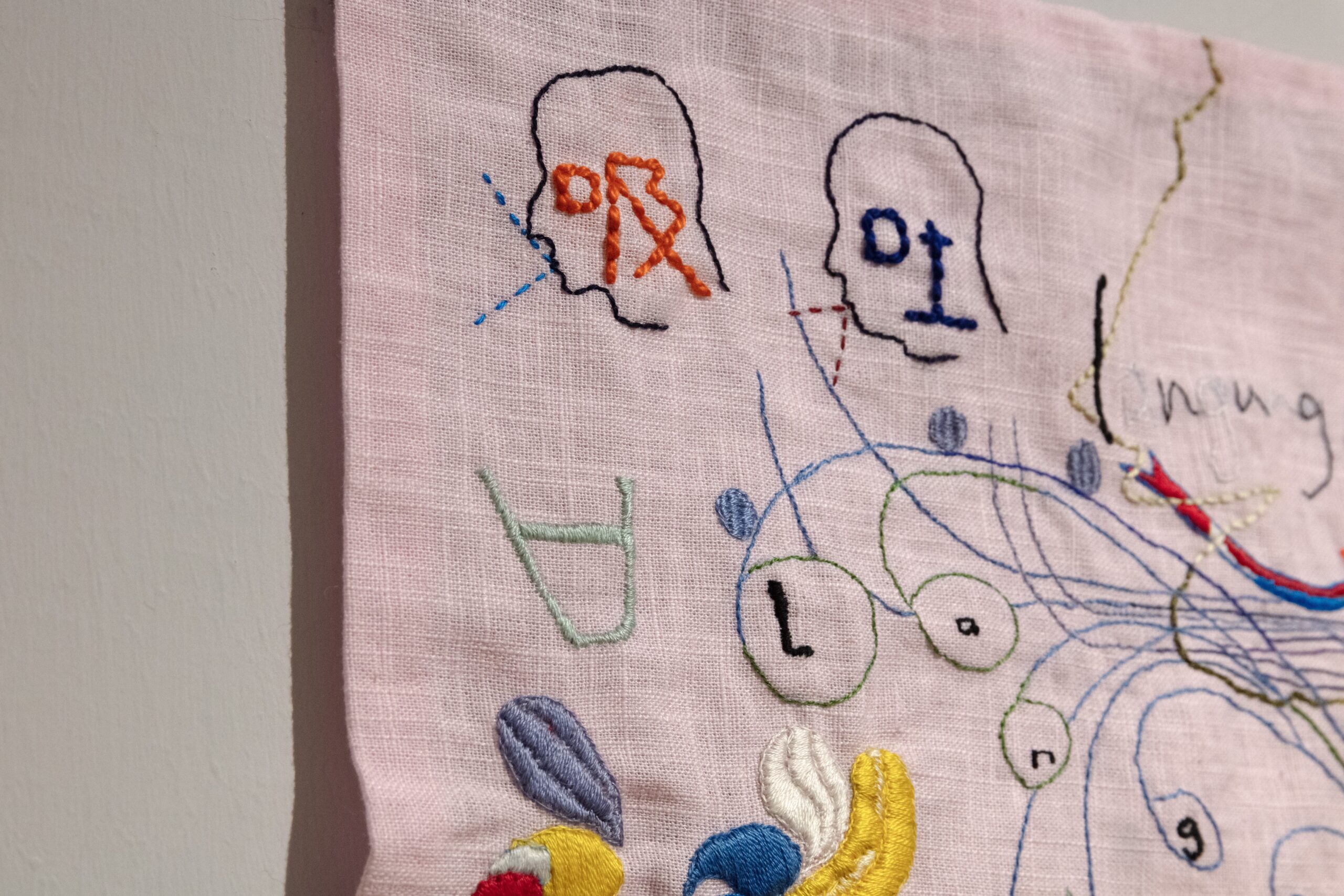
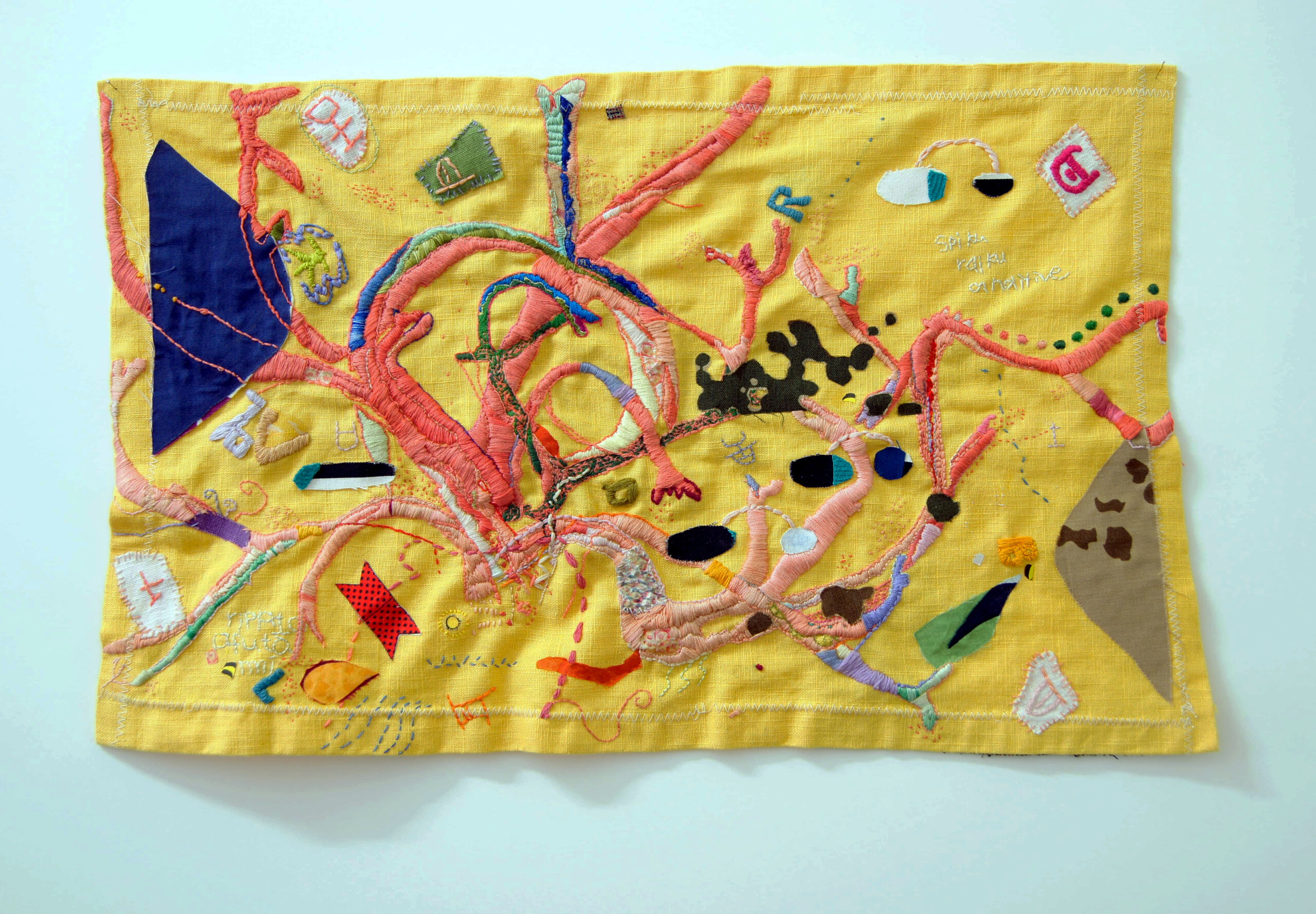
spiku raiku a neitibu (Speak Like A Native), 2024, textile collage with hand sitiching embroidery on fabric,  49x31cm

I had an idea for my textile collage with hand-stitched embroidery work titled spiku raiku a neitibu (Speak Like A Native), 2024, 49x31cm, from my life experience. When I speak English or German which are my second and third languages, I am misunderstood people what I say, because of my pronunciation. My accent does not sound like a native speaker. I practiced my tongue to pronounce these two languages correctly. I wanted to be a native speaker. But one day, somehow, I stopped disciplining my tongue. Instead, I imagined that my tongue would become seaweed. My seaweed-tongue separates a few as many serpents’ tongues aggregate. It moves freely, sings, and speaks any language, not just human language. I communicate with animals, plants, and stars. I depicted such an imaginary scene in spiku raiku a neitibu (Speak Like A Native). How does language metamorphose when I struggle to make myself understood in a life outside of my mother tongue?  The title of the work; spiku raiku a neitibu is allocated alphabets the English saying “Speak Like A Native.” is allocated to the alphabet, phonetically, into my pronunciation. 

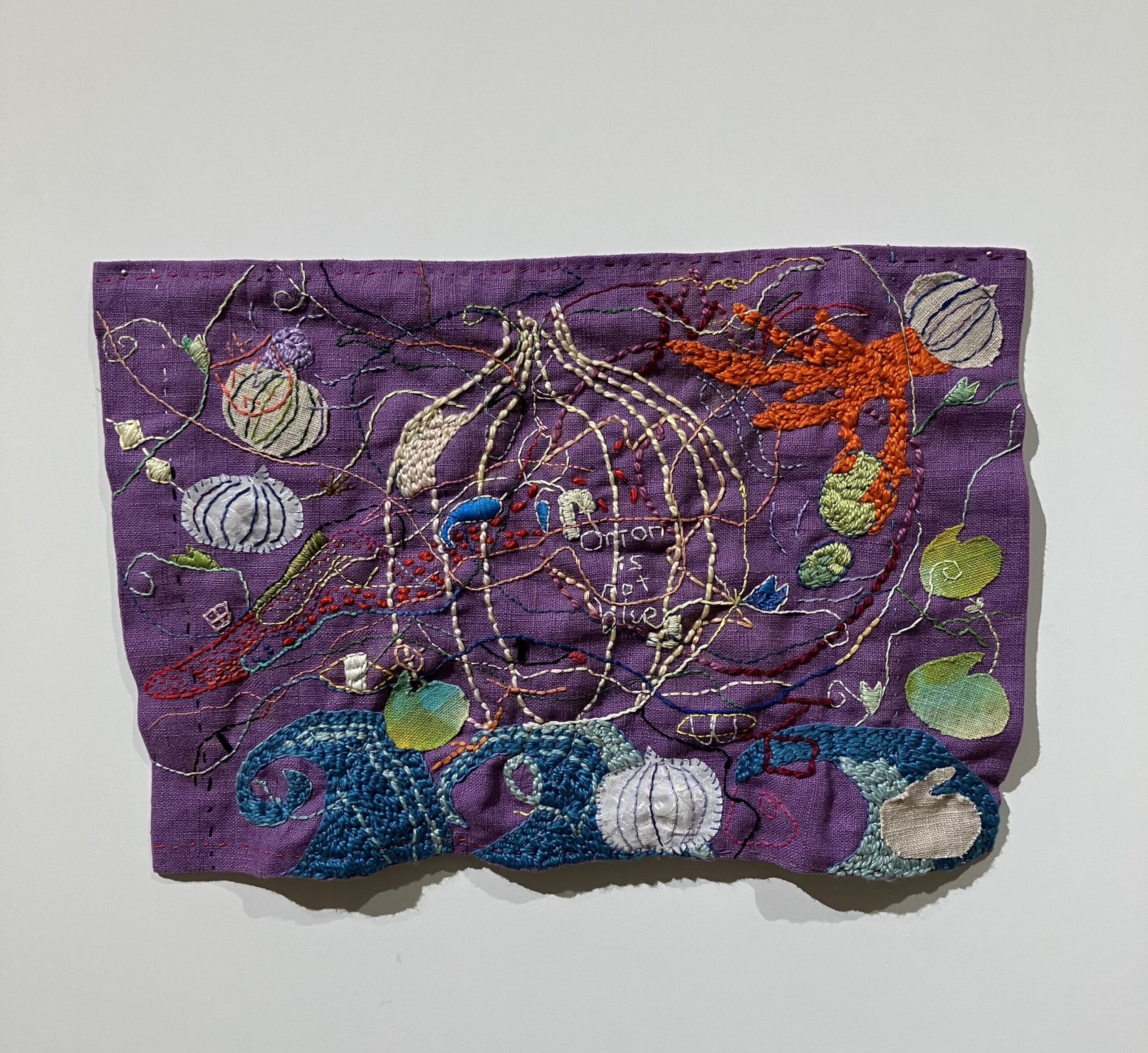
Onion Is Not Blue, 2024, textile collage with hand stitching emboridery, 30 x 20.5 cm

If patterns can speak, what are they willing to talk about? Could I listen to them? I had an idea about my textile work, Onion Is Not Blue through reading an article about Meissen porcelain’s Blue Onion (Zwiebelmuster). The Blue Onion’s name derives from a misunderstanding of a pattern of pomegranates as onions. The semioticity of the pattern is coded by cultural myth; it exposes a regulation of what you know and do not know. Onions, their name and representation have been performing well for the culture, instead of pomegranates. Even though fruits are not humans or animals, I can’t help but rescue pomegranates; the artworks sometimes can begin to be produced, not as a creation but as a negation, refusal, and re-contextualization. The title of the work used a negative form to reflect it. 

柘榴 桃 玉葱


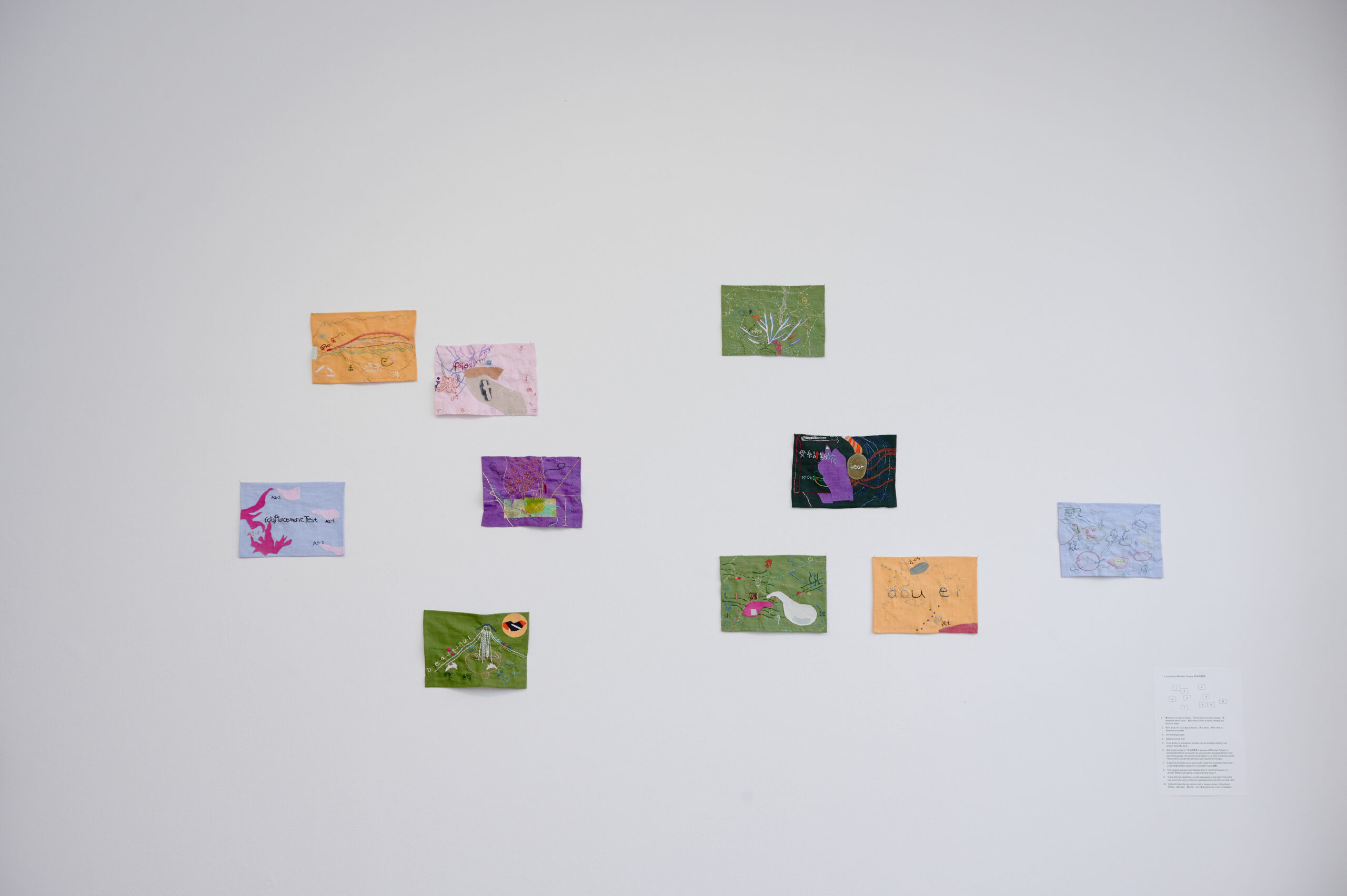
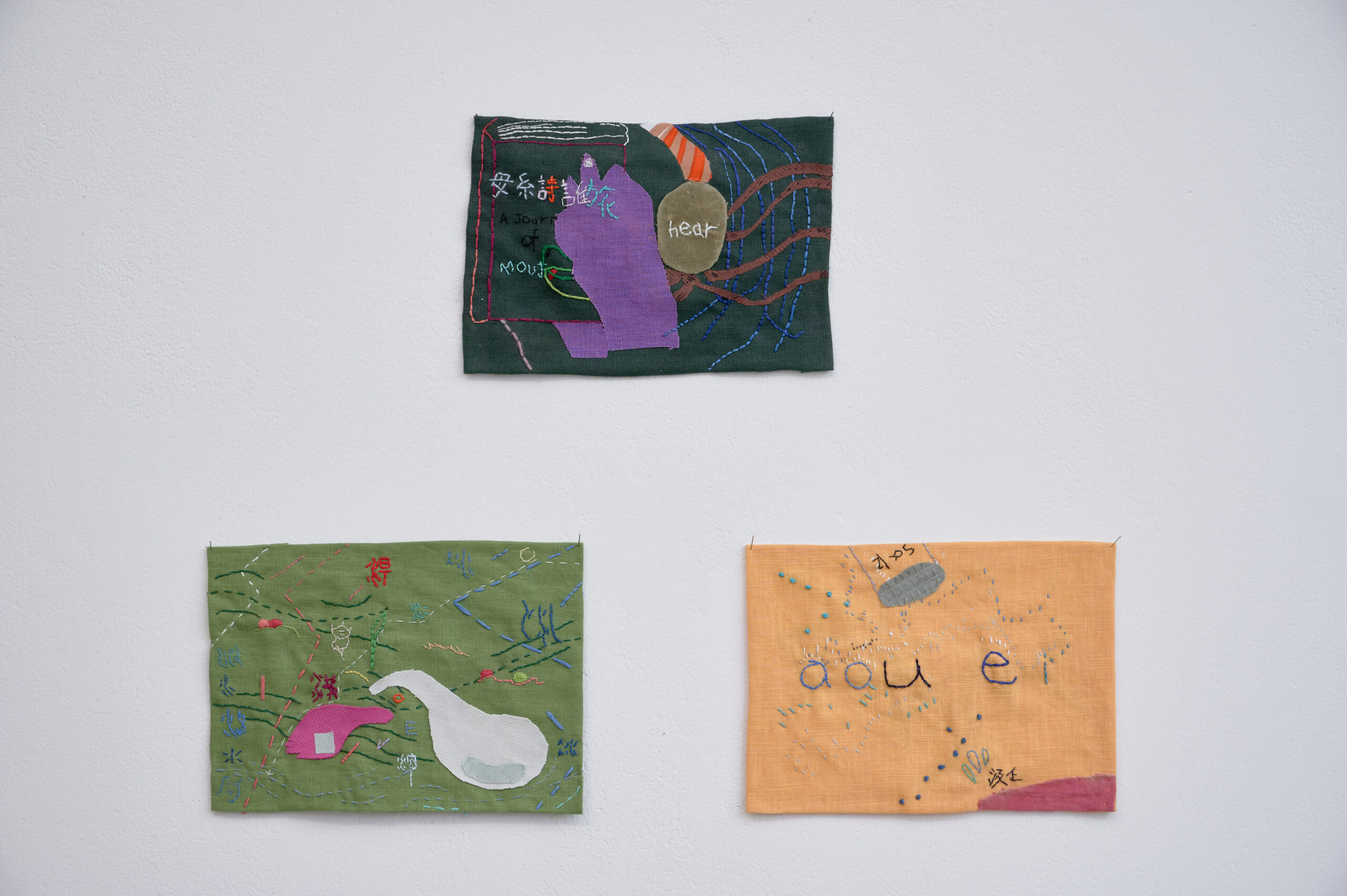
A Journey of Mouther Tongue 母糸詩誰旅, 2024, textile collage with hand stitching emboridery, various sizes 

1. to hurt, to hate, to fullest、舌thousand mouthes, tongue、渡 ferryboat, ferry, cross、漂 to float, to drift, to wave, faraway, put them on water 

2. Burn a ice ! ice cube, to freeze、泳 to swim、溶to melt, to dissolve, to soulble

3. die Seetangzungen

4. (dis)placement Test

5. A cat works on a reception handed over an invitation letter to her, written ‘Dear Ms. Asia’.

6. She found a book of  母糸詩誰旅 A Journey of Mouther Tongue” in her grandmother’s bookshelf. Her grandmother already had lost in her second language. Her grandmother spoke to her with mysterious words. Those words sounds like a Emojis spark grandma’s tongue.

7. A spirit of mountain has a buck-tooth. Under the mountain, there is an ocean,兎兎 rabbits skipped on crocodiles heads鰐鰐。

8. Two tongues discuss  their attitude when if next time they are in a dentist. What of any genre of dance do they dance?

9. To eat German alphabets, on salt and pepper is fine taste. This is the tale about why some of  German alphabets have two dots on a top- äöü.

10. If afterlife has only two options: hell or heaven we go, I am going to float、溺drawn、漂draftand breathe into a river in-between. 


A Journey of Mouther Tongue 母糸詩誰旅 ははしたたび ははがしたたび? hahashitatabi

Courtesy of VBKÖ, © Photo: Daniel Hill
ことばが、果物だったらどんなにいいだろう。
実になるまで待って、それまで、葉が繁って、つぼみがつぶれないようにときどき様子をみて、花になると開いた世界をよろこんで、花びらのあとは、生まれ変わりの、青い実が熟すのを待っている。
ひとつの単語が、動詞が、副詞感嘆詩イディオム言語第二言語
歯をくぐりぬけて体内から溢れ出るまで、話す人を待つことができたらいいのに。
急ぎすぎる人生。すぐに知りたがAddiction。
何日でも、何ヶ月でも,何年でも、君のことを待っている。その口からあらわれる、音を、意味を、摩擦を、声を、楽しみに、待っている。
5月25日,2024